
A copied fly brain in a painted world
A neural wiring map, a physics body and 260 foraging trials explored the path from smell to food seeking.
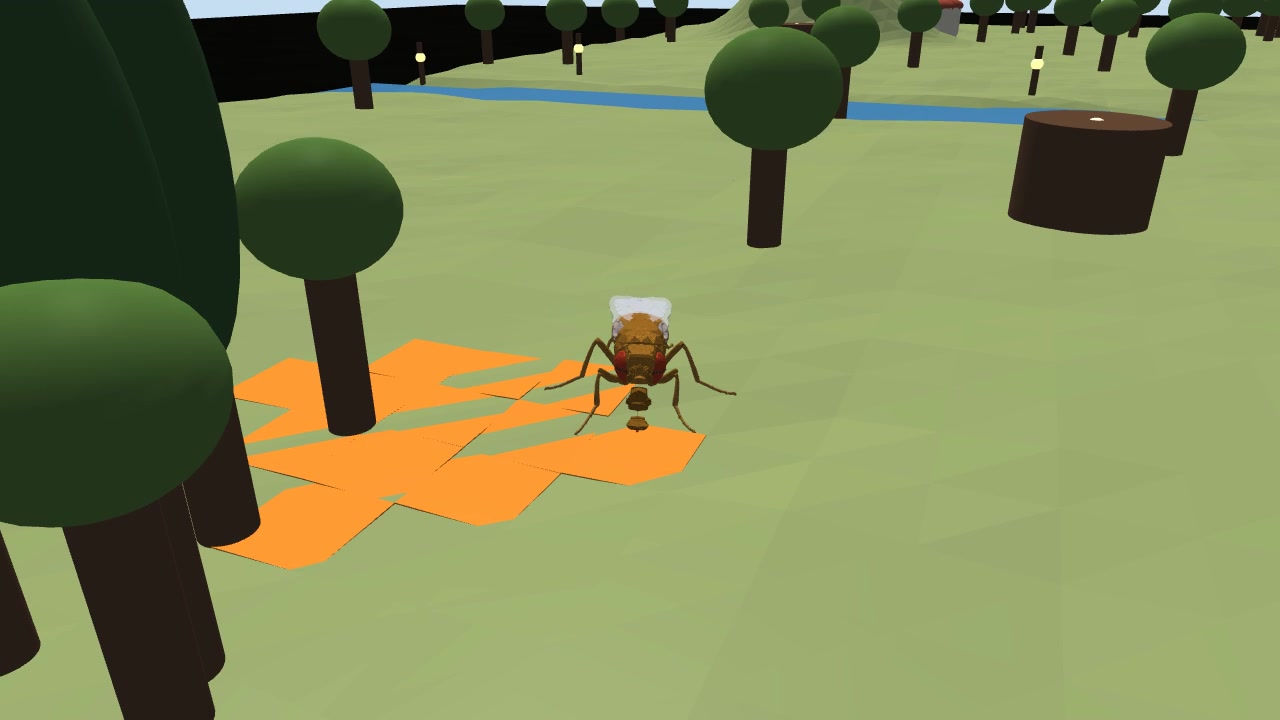
We placed a simulated fly in landscapes made from paintings and hid food in each world. We wanted to know whether a neural network based on a fly wiring map could turn sensory input into movement toward food. Across 65 tries, a fly helped by a steering rule found food 11 times. The version controlled by the neural network found it once.
From a painting to a world
Paperworld turns painted regions into a landscape the simulator can use. It exports nine labelled layers on a 96 by 96 grid, including areas such as forest, meadow, water and hills. The same landscape can be used again while the fly's controller changes.
The fly combined a spiking neural network derived from a wiring map, a NeuroMechFly body and MuJoCo physics. Spiking networks represent neural activity as pulses. The body and physics determine how movement meets the terrain. In one condition, hand-written rules helped steer; in another, the chosen neural output controlled movement.
The environment was more than a backdrop. A forest could present obstacles, a hill could affect the body’s footing, and a food patch could provide a target. The combination made the task harder than simply detecting a signal: the fly had to move through a physical landscape and arrive at a particular place.
Smell reached the sensors, but not the turn
We supplied separate odor signals to simulated receptors on the left and right. Food, forest and village regions produced different inputs. The first question was whether the receptors responded. The second was whether a smell on one side caused a reliable change in the signal used to turn the body.
The receptors responded, but most of the left-right difference was lost before it reached the selected turning output. Smell also strongly suppressed the output used for walking. Some other output cells showed a difference between sides, but they were not the chosen route for steering in this comparison.
The helped condition used receptor activity for sensing and a hand-written rule for turning. The brain-controlled condition used the selected neural output for movement. Comparing them helped show which part of the path was working and which part needed more work.
Think of the turning output as a message from the network to the simulated body. For a smell to guide a turn, information about which side smells more strongly needs to survive along that route. The observed receptor response showed that the input entered the system; it did not establish that the final movement command contained enough information to steer.
Making the landscape physical
Foraging depends on the body meeting the world in sensible ways. During development, flies could pass through trees, shallow water did not trigger the intended sinking effect, and a fly could appear to feed without actually swallowing. Those issues were corrected before the final comparison.
The fly also needed a way to recover when tipped over. On a steep hill, resetting the body level could place its legs inside the slope, causing the physics system to throw it upward. Fixing these interactions mattered because terrain and movement both influence whether food can be reached.
Four conditions, 65 tries each
The comparison used 13 food placements across three worlds, with five starts for each placement and four controller conditions. Each of the 260 trials lasted 60 simulated seconds.
With all landscape smells and rule-based steering, the fly found food 11 times out of 65. With only food smell and the same steering help, it found food nine times. The no-smell condition and the brain-controlled movement condition each found food once.
Each condition had the same number of opportunities to find food. The rule-steered conditions helped us ask whether the sensory setup could support foraging when a separate rule translated that input into turns. The brain-controlled condition asked whether the selected neural-to-movement path could do so by itself. Neither comparison makes a claim about how a living fly would behave.
| Condition | Food finds |
|---|---|
| All landscape smells and rule steering | 11 / 65 |
| Food smell only and rule steering | 9 / 65 |
| No smell | 1 / 65 |
| Brain-controlled movement | 1 / 65 |
Following the path from sense to action
In this setup, a response at the smell receptors did not become reliable food seeking through the chosen connection between neural output and movement. Finding food was also different from eating it or recovering energy, which were not the reported endpoint.
The result applies to this simulated network, its sensory inputs, movement mapping and physical worlds. Some terrain made food difficult to reach. A useful next step would compare a different, chosen-in-advance movement signal with a baseline where food is known to be reachable. The experiment gives us a concrete place to investigate: how a sensory difference can become a useful turn.